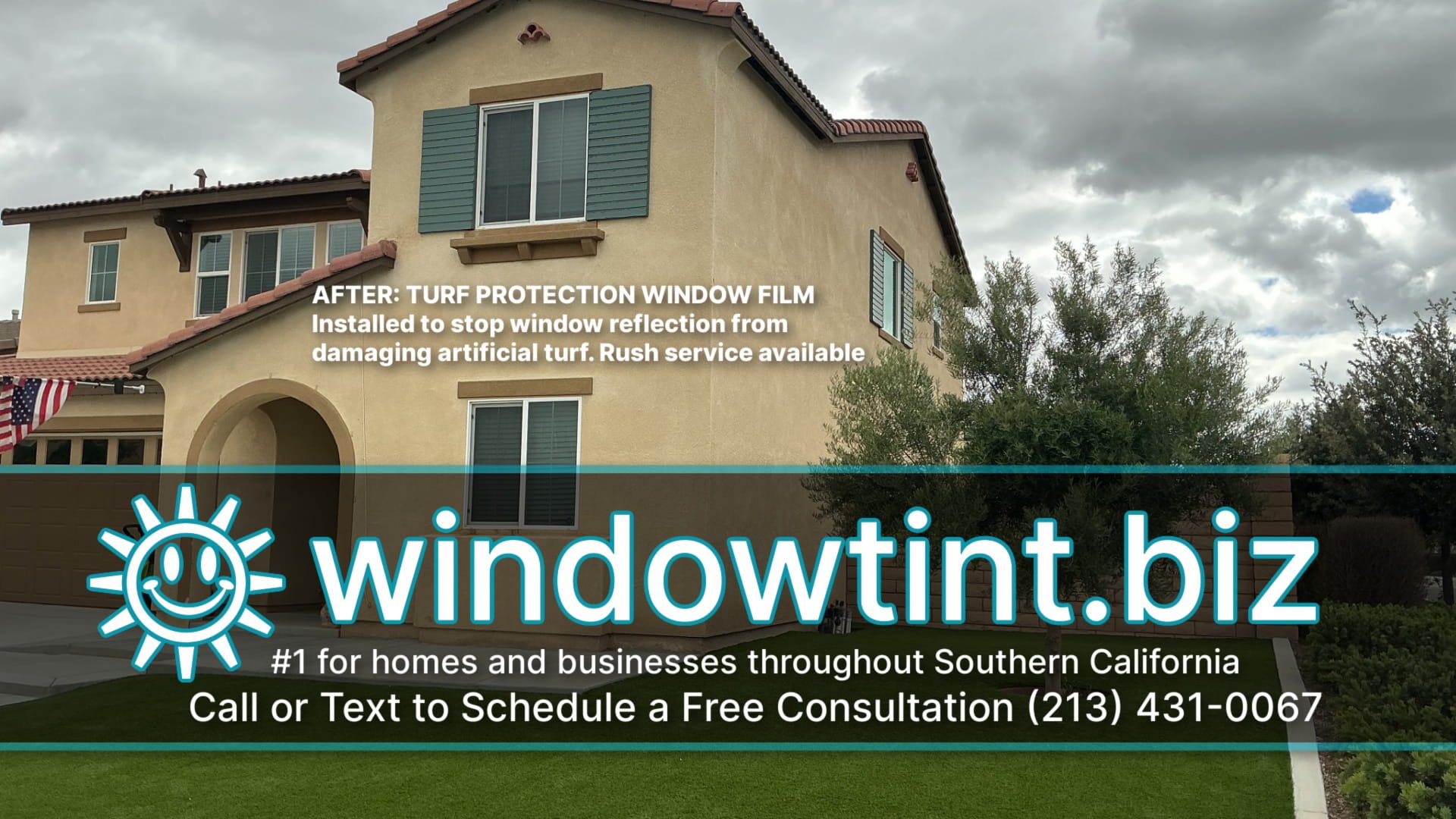
Is Your Neighbor's Window Reflection Melting Your Artificial Grass?
When a bright reflection crosses the fence and reaches damaged artificial grass, the next step is to confirm the source and work out whether the reflecting glass can be treated. The window closest to the damage is not necessarily responsible, and a melted-looking patch alone does not identify its cause.
Window Tint Biz offers free on-site consultations across Southern California. We assess the concern from places we have permission to access, take measurements and project photos, show suitable film samples, and explain what can be recommended. Work on another property's glass requires the appropriate owner's authorization and access.
Can the assessment start from my property?
Yes. We can begin with the affected area and the glass visible from your property, within the access you authorize. If you already know roughly when the reflection appears, mention it. You do not need to collect a set of photos, test surface temperatures, or follow the glare into someone else's yard before booking.
The relationship between the glass, sunlight, and receiving area matters. Doors, upper-story windows, and more than one pane may need consideration. The National Glass Association's reflected-solar-energy guidance explains how sun angle, glass shape, and surrounding features affect reflected exposure.
Sometimes the suspected reflection is not present during the appointment. We can still review the setting, but a further check under relevant sunlight conditions may be needed. A view across the boundary also cannot establish every detail of the other property's glass or installation access.
Who needs to be involved before window work can go ahead?
There are two sides to the proposed work:
The owner of the affected yard can arrange access to the turf area, explain what has changed, and coordinate any landscaping repair or redesign.
The person authorized to approve work on the reflecting glass needs to agree to the proposed treatment and access. They should understand its appearance, suitability, care requirements, and quoted scope before installation is scheduled.
For a rental, condominium, or HOA-managed property, the occupant may not be the person who can approve changes to the windows. Establish who controls the glass and whether a manager or association has an approval process. We can explain the proposed film work, but the consultation does not grant permission to alter another owner's windows.
A first conversation can stay practical: there is a suspected reflection affecting the lawn, and you would like the glass and possible treatment assessed. It is more useful to discuss a specific proposal once the source, product, and access have been checked than to ask someone to approve unspecified window tint.
What will the window owner want to know?
Even if the concern starts in your yard, the treatment changes their glass. Their questions about daylight, views, exterior appearance, and maintenance belong in the decision.
We bring samples and explain the proposed finish. Specialist products can have a visible screen-like, patterned, perforated, or toned appearance. A clear-looking product should not be described as invisible, and a treated pane may look different from neighboring untreated glass.
We also review the actual glazing, existing coatings or film, and the product's approved application surface. Low-E, double-pane, or tempered glass is not enough information by itself to approve every film. Any effect on applicable window and film warranties needs a product-specific review.
An ordinary interior film selected for room comfort may leave the exterior reflection unresolved. Our turf-protection film versus solar tint guide explains why the treatment must be chosen for the outdoor problem.
How do access and approval affect the quote?
The recommendation may require the exterior face of the reflecting glass. A second-story window, sloping ground, a pool, or limited side-yard space can affect installation access and equipment. Permission to inspect the damaged lawn does not provide permission to enter the neighboring property or reach its windows.
Before a firm installation scope is agreed, we need to confirm the relevant panes, product suitability, authorized access, and any necessary approvals. Where those details are available during the consultation, we can quote on the spot. If they are still unresolved, we explain what must be established before the work can be priced or scheduled confidently.
The quote describes the proposed glass work. It does not decide responsibility for turf damage or settle who pays. The people involved should agree who authorizes the installation and who accepts the quote before booking it.
What if the owner cannot approve film, or the glass is unsuitable?
Keep the landscape decision open while the window question is unresolved. Applying film to your own unrelated windows will not address a reflection that originates on another property.
Depending on the site, a landscape professional may be able to consider a different lawn boundary, a suitable alternative surface in the affected area, or an appropriately positioned shade structure. On the reflecting property, an approved exterior screen or shading option may also merit assessment with its owner. None should be assumed effective simply because it sits near the damaged patch; its position and coverage must address the relevant exposure.
Avoid committing to another turf patch on the assumption that the reflection has gone away. Film cannot restore melted fibers, and a different turf product should not be assumed immune to an unresolved concentrated reflection. Our guide to already-melting artificial grass explains how the glass assessment and turf repair fit together.
What can the consultation confirm?
We aim to leave you with a useful next step: a supported source assessment where conditions allow, a suitable treatment option if one is available, and a clear account of the access or approval still needed.
We do not identify a responsible neighbor from a damaged patch alone. We also cannot certify all future sun conditions from one visit, approve work for an absent property owner, or promise that a particular film will suit glass we have not adequately checked.
You can arrange an initial visit without first resolving every question with your neighbor. We will be clear about how far the assessment can go with the access available and what needs their involvement.
Relevant Southern California experience
Our published Temecula turf-reflection project involved a specialty exterior film selected to address reflections affecting artificial grass. It shows the type of glass-and-landscape problem we work on. Each new property's glass and access still need their own assessment.
A concern involving two properties adds permission, appearance, and access decisions to that assessment. We serve homeowners throughout Southern California and can explain those practical requirements during a free on-site consultation. Our team handles measurements and project photos, brings samples, and answers your questions. For the wider service overview, see window reflection and turf protection.