
Choosing Solar Window Film for a Coastal Condo
A coastal condo can need heat control without losing the view that makes the home special. The useful comparison goes beyond how dark a film looks: it includes the existing glass, reflection toward the room, salt-air exposure and the details around the film's edges.
For Southern California coastal properties, distance from the ocean can even change a manufacturer's installation requirements. A fixed living-room pane and an opening balcony window may need different treatment despite sharing the same view. Here is how to narrow the product choices before committing to a film.
Compare suitable options at home
Request a free on-site consultation. Our team visits, measures your windows, brings samples, answers questions and provides a quote. You do not need to choose a brand or measure the glass before booking.
Build a shortlist around the room's needs
We offer five architectural film brands. These examples provide different starting points for a coastal assessment; the exact grade still depends on your windows.
Keep a bright room feeling open: compare Hüper Optik Select Sech and lighter Ceramic choices with Avery Dennison SP e-Lite interior. Daylight-preserving options warrant a separate glare check where low sun reaches a television or desk.
Prefer a less reflective appearance: consider LLumar Ceramic, Solar Gard Panorama CX and XPEL VISION Clear View Ceramic. Compare the individual shades rather than assuming every ceramic film looks alike.
Compare another solar-control construction: XPEL Clear View Plus belongs beside those samples, with its own coastal edge-sealing requirement. A similar-looking sample can carry different installation conditions.
For example, Solar Gard describes Panorama CX as a low-reflectance ceramic family and publishes CX 35, CX 50 and CX 60 separately. That is a useful choice of light levels, not a reason to select one grade for every room.

Rebecca Houston · 5-star Google review
Excellent service! Great communication. On time and professional from start to finish.
Complete short review. General customer feedback.
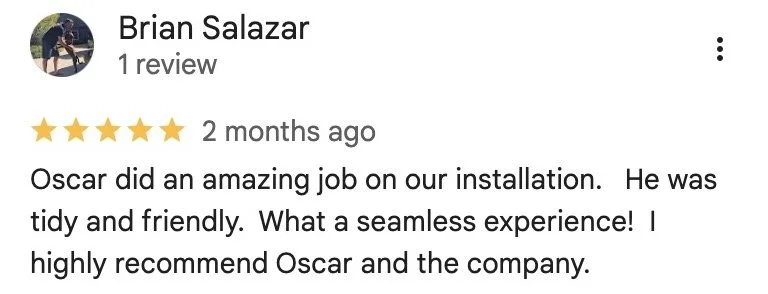
Brian Salazar · 5-star Google review
Oscar did an amazing job on our installation. He was tidy and friendly. What a seamless experience! I highly recommend Oscar and the company.
Complete short review. General customer feedback.
Separate daylight, glare and reflections
Visible light transmission describes how much visible light passes through the filmed glazing. A lighter option may suit a shaded dining area, while a sun-facing screen may need stronger glare reduction. A film's grade number is not a guaranteed measurement for your existing window.
Compare exterior reflectance and interior reflectance separately. The first affects the facade; the second helps describe reflections toward the room. Both should be considered alongside lighting, glass color and the view from the usual seating position. A sample viewed against white paper cannot settle how the window will look at home.
A useful sample discussion asks: Will the room stay bright enough away from direct sun? Will lamps reflect in the glass after dark? How does the proposed finish sit beside neighboring untreated panes? Adjustable shades may still be useful for direct low-angle sun and nighttime privacy.
Coastal edge treatment differs by product
Salt-air exposure deserves a product-specific answer. Two documented requirements show why a general promise about “coastal film” is insufficient:
Avery SP e-Lite interior: the interior warranty schedule requires edge sealing within 10 miles of the sea. Its exception concerns fixed, stationary windows that are not exposed to the environment. An opening window should not be treated as that exception simply because it is usually closed.
XPEL: the film-to-glass guidance calls for edge sealing within 25 miles of the ocean for Clear View Plus, Clear View Alloy and All Season 45. Those named-product conditions should not be generalized to every XPEL film.
LLumar describes its Ceramic construction as not requiring edge sealing for salt-air corrosion protection. That family-specific feature does not establish compatibility with every window, and it does not make the window frame or seals immune to coastal wear.
The quote should identify any required edge treatment, its appearance and the applicable care instructions. Required film-edge sealing is separate from repairing a leaking frame or a failed insulated-glass seal.
Check each window type and the access it needs
A condo may contain original fixed panes, replacement insulated units and a sliding door with different glass. Coating location, existing tint, pane size, damage and shade from balconies or overhangs all belong in the suitability assessment. “Double-pane” or “low-e” alone does not identify an approved film-and-glass combination.
Access also affects the choice. The assessment should distinguish room-side installation from any exterior work and consider screens, balcony access, controlled building entry and future cleaning. A view-facing elevation does not automatically call for exterior film.
Building appearance requirements remain a separate decision. Our condo and HOA approval guide covers that process; this product comparison does not establish association approval.

Edwin Monsen Jr. · 5-star Google review
Quick, clean and professional. Very much recommended!
Complete short review. General customer feedback.

Daniel Gomez · 5-star Google review
Excellent Service I had an excellent experience with Window Tint Biz!
Review excerpt. General customer feedback.
Coastal condo film questions
Does a fixed panel beside a sliding door qualify for the same edge detail?
Not automatically. The fixed panel and moving panel need to be identified separately, including their exposure. The selected manufacturer's written conditions determine whether an exception applies.
Can two ceramic films be compared by their names alone?
No. Compare the exact grades, published light and reflectance data, glass suitability and samples. A ceramic label does not establish matching appearance or equivalent warranty coverage.
Will solar film fix fogging between the panes?
No. Existing insulated-glass problems need evaluation before a film recommendation. Film coverage and any glass or seal-failure coverage are separate, conditional parts of the written warranty.
Find the right balance for your coastal windows
Book a free on-site consultation anywhere in our Southern California service area. We bring samples, take measurements and explain the suitable options and quote, including any edge-treatment or access questions that affect the work.